.svg)



UX audits can help identify usability issues, conversion barriers and growth opportunities faster, while highlighting why human expertise remains critical for making the right decisions.
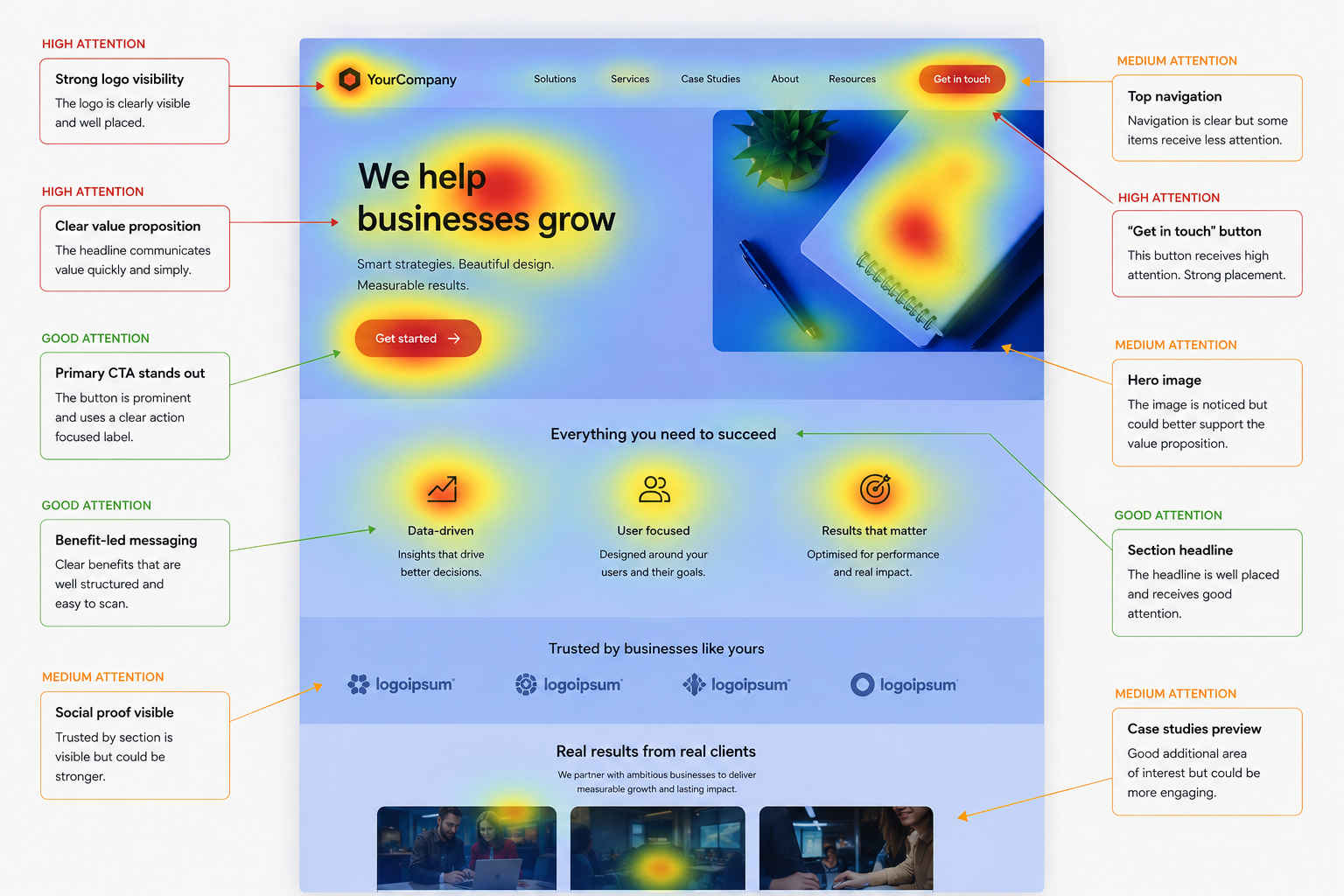
Artificial Intelligence is changing the way websites and software platforms are reviewed, tested and optimised. Tasks that once took days of manual analysis can now be completed in a fraction of the time, allowing UX professionals to uncover opportunities faster and focus on making better decisions.
However, while AI can accelerate the audit process, it cannot replace experience, business understanding or strategic thinking. The most effective UX audits combine the speed of AI with the expertise of an experienced UX and Conversion Rate Optimisation specialist.
About the Author
Rob Hufton has worked in UX Design, CRO and Product Design for more than 20 years, helping organisations improve websites, ecommerce platforms and software products. He combines traditional UX research methods with modern AI tools to accelerate discovery, identify opportunities and improve business performance.
What is an AI UX Audit
An AI UX Audit uses artificial intelligence to analyse a website, ecommerce store or software platform and identify potential usability, conversion and content issues.
Depending on the tools used, AI can review:
- Page layouts and visual hierarchy
- Calls to action and conversion paths
- Content clarity and messaging
- Mobile usability
- Navigation structures
- Accessibility considerations
- Search visibility and AI search readiness
- User journey friction points
The result is a faster and more comprehensive starting point for identifying areas that may be impacting user experience or business performance.
Why Traditional UX Audits Take Time
A thorough UX audit often involves reviewing multiple areas of a digital product, including analytics, user journeys, content, competitor websites and conversion funnels.
For larger websites or software applications, this process can take several days. Experienced UX consultants are required to understand not only what users are doing, but why they are doing it.
This is where AI can help.
Instead of manually reviewing every page and interaction, AI can quickly surface patterns, inconsistencies and opportunities that warrant further investigation.
What AI Does Well
AI excels at processing large volumes of information quickly.
For example, AI can:
- Review hundreds of pages for consistency
- Analyse customer feedback and survey responses
- Identify recurring usability issues
- Compare competitor websites
- Highlight conversion bottlenecks
- Generate potential improvement ideas
This allows UX specialists to spend less time gathering information and more time evaluating solutions.
For example, on a large ecommerce or SaaS platform, AI can analyse hundreds of screens and interactions in a matter of hours, providing a level of coverage that would be difficult to achieve manually within a typical project budget.
Where AI Falls Short
Despite its capabilities, AI does not understand your customers, business objectives or industry context.
AI may identify that a form contains too many fields, but it cannot determine whether those fields are commercially necessary.
AI may suggest simplifying a user journey, but it cannot always understand regulatory requirements, stakeholder priorities or commercial constraints.
Most importantly, AI cannot replace conversations with customers, stakeholders or users.
Experience still matters.
The role of a UX consultant is to interpret findings, prioritise recommendations and determine which improvements are most likely to deliver measurable results.
A common mistake is assuming every issue identified by AI deserves equal attention. In reality, some observations may have minimal impact, while a small number of key changes could significantly improve engagement, conversions or task completion rates.
The Best Approach: AI and Human Expertise
The strongest audits combine both approaches.
AI provides speed, scale and analysis.
Human expertise provides judgement, context and prioritisation.
At Higher Ground, AI is used to accelerate the discovery process, allowing more time to focus on the recommendations that genuinely improve user experience, conversion rates and business performance.
This approach delivers faster insights while maintaining the strategic thinking that businesses rely on when making investment decisions.
Think of AI as a highly efficient research assistant rather than a replacement for UX expertise. It can gather evidence, identify patterns and highlight opportunities, but experienced practitioners still need to determine what matters most and why.
What Should a UX Audit Include?
A modern UX audit should typically cover:
User Experience Review
- Navigation and information architecture
- Page layouts and content hierarchy
- Mobile usability
- Accessibility considerations
Accessibility should form part of every review, with guidance available from the W3C Web Accessibility Initiative (WAI), which promotes accessible digital experiences for all users.
Conversion Review
- Calls to action
- Lead generation opportunities
- Checkout or enquiry journeys
- Funnel performance
Content Review
- Messaging clarity
- Value proposition effectiveness
- Trust signals
- Content gaps
Search and Visibility Review
- SEO foundations
- AI search visibility
- Content opportunities
- Competitor positioning
Prioritised Recommendations
Most importantly, businesses need a clear roadmap of improvements ranked by impact and effort.
Finding issues is easy.
Knowing which issues to fix first is where expertise adds value.
Real World Benefits
For product teams, SaaS businesses and digital agencies, the practical advantages of an AI assisted UX audit are significant.
Speed
Large websites and software platforms often contain hundreds of screens, pages and user flows. AI can analyse content, layouts, navigation structures and user journeys far faster than traditional manual methods.
Broad coverage that might take weeks manually can often be completed within days. This is particularly valuable when working towards a product roadmap, launch deadline or major release.
Consistency
Automated analysis tools don't get tired, distracted or influenced by assumptions. Across a large website or application, consistency of coverage can be extremely valuable.
AI helps ensure that every page, workflow and interaction is reviewed using the same criteria, making it easier to identify recurring patterns and usability issues.
Cost Effectiveness
By automating repetitive review tasks, more project time can be focused on the activities that create the most value:
- Interpretation
- Prioritisation
- User behaviour analysis
- Strategic recommendations
Rather than paying consultants to spend hours gathering information, businesses benefit from more time being spent solving problems.
Confidence
Whether you're building a business case for a redesign, a new feature release or wider UX investment, having both data and expert analysis behind your recommendations makes them easier to defend.
The evidence-based design principles promoted by Nielsen Norman Group consistently show that informed design decisions outperform assumptions and opinion-led changes.
Scalability
AI tools can analyse a 200-page website just as easily as a 20-page website.
For larger organisations and complex software platforms, this dramatically changes what can be reviewed within a reasonable timeframe.
Instead of sampling a handful of pages or journeys, teams can gain a much broader understanding of the user experience.
Better Decision Making
Ultimately, the goal is not to find more issues.
The goal is to make better decisions.
AI can generate hundreds of observations, but the real value comes from understanding which issues matter most to users and which improvements will have the greatest business impact.
This reflects the principles of user-centred design promoted by the Interaction Design Foundation and UXPA International.
What doesn't change is the need for human expertise at the interpretation and strategy layer.
Teams that treat AI as a replacement for UX expertise often end up with lengthy lists of issues and no clear sense of what to do next.
Teams that treat AI as a tool in the hands of experienced practitioners gain something much more valuable:
Clear direction. Faster.
The Future of UX Audits
AI is already transforming how UX audits are performed and this trend will continue.
Businesses can expect faster analysis, broader data coverage and more detailed insights than ever before.
As AI tools continue to evolve, they will become increasingly effective at identifying patterns, surfacing usability issues and supporting research activities. However, successful digital products will still depend upon understanding human behaviour, customer needs and commercial objectives.
The most successful organisations will not replace UX professionals with AI.
They will equip UX professionals with AI.
Those who combine automation with experience, research and strategic thinking will gain a significant competitive advantage.
AI can identify opportunities.
People decide which opportunities matter.
Looking for an AI Powered UX Audit?
Whether you manage a marketing website, ecommerce platform or software application, an AI assisted UX audit can help uncover usability issues, conversion barriers and opportunities for growth.
At Higher Ground, we combine AI powered analysis with more than 20 years of UX, CRO and product design experience to identify what is working, what is not, and where the greatest opportunities for improvement exist.
If you would like an independent review of your website or software platform, get in touch to request an AI Powered UX Review and discover where your biggest opportunities lie.